
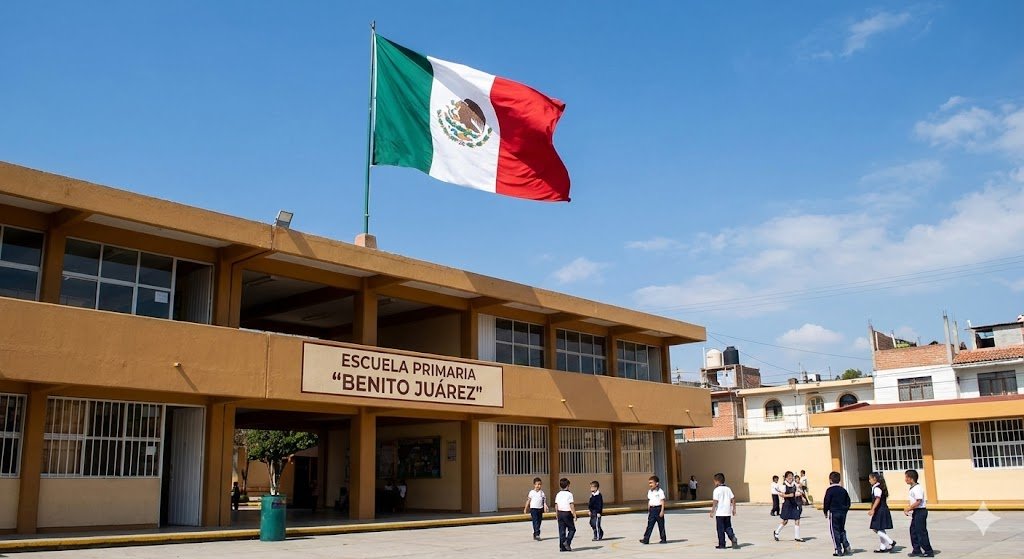

There are problems that, because they are uncomfortable or painful, the country has preferred to look the other way. Childhood is one of them. For decades, Mexico has advanced behind solemn speeches and cold statistics, while children and adolescents continue to grow up in environments marked by violence, poverty, institutional neglect, and social indifference. Today, when we talk about protecting children, we risk treating it as a moral luxury—something noble, but not urgent. And yet, the Mexican Constitution and the laws that stem from it tell a very different story: childhood is not a secondary concern, but a structural pillar of the nation’s project.
If one goes back to the origins of the contemporary Mexican state, one finds that the constituents of 1917 had a central concern: to build an order that would limit abuse, correct deep inequalities, and place human dignity at the center. For them, the state did not emerge as an impersonal machine or as a distant authority; it arose to protect people from injustice and to ensure that power was not re-entrenched in its concentration. This conviction was reflected in social rights, in public education, in the social function of property, in labor rights. And although at that time children did not occupy the place they have today, the seed of a State responsible for the well-being of the most vulnerable was sown.
With the passage of time and especially after the constitutional reform of human rights in 2011, this vision was transformed into an explicit mandate. Article 4 of the Constitution recognizes children and adolescents as subjects with full rights. It establishes that the best interests of children must guide all public and private decisions that affect them. This principle—so repeated and so seldom understood—obliges the State to reorganize its priorities: it is not a decorative phrase, it is a legal and ethical compass.
The Constitution goes further: it requires the State to guarantee their integral development, their education, their health, their identity, their right to live free from violence. In other words, he recognizes that childhood must come first. And when the rights of children clash with the interests of adults – parents included – it is the rights of the child that prevail.
This shift towards a comprehensive vision of childhood was the terrain on which, years later, one of the most important laws in the country would emerge: the General Law on the Rights of Children and Adolescents (LGDNNA), enacted on December 4, 2014. Its birth cannot be understood without looking at the context in which it occurred. Mexico was going through a particularly dark time: the disappearance of the 43 students from Ayotzinapa had brutally exposed the fragility of the state and the violence that the country was going through. But there were also alarming figures on child sexual abuse, criminal recruitment, child labor, human trafficking, femicides of girls and adolescents. Mexican children were at risk and institutions did not provide effective responses.
Despite the fact that Mexico had ratified the Convention on the Rights of the Child in 1990, for more than two decades it did not create a system capable of making those commitments a reality. The UN Committee pointed it out insistently: there was no inter-institutional coordination, there were no comprehensive protocols, public policy on children was fragmented and reactive. In the diplomatic language of international reports there was a harsher message: Mexico was failing its children.
The LGDNNA emerged, then, as a response to that historical debt. For the first time, the law clearly recognized that children and adolescents have progressive autonomy, the right to be heard and to have their opinion taken into account in all processes that affect their lives. Childhood ceased to be seen as an incapacity and began to be understood as a period of development that requires respectful accompaniment, not absolute control.
One of the most relevant changes was the creation of the National System for the Comprehensive Protection of Children and Adolescents (SIPINNA), in charge of articulating all institutions and the three levels of government. Childhood ceased to be “a matter for the DIF” and became a matter for the State as a whole. Schools, hospitals, prosecutors’ offices, prosecutors’ offices, police, human rights commissions and local governments were obliged to generate coordinated policies. Protection would no longer be a voluntary act, but a legal mandate.
Behind that law there was also a silent, constant and determining social force. Organizations such as REDIM, UNICEF and dozens of collectives, academics and specialists lobbied for years, in a country that has often preferred to remain silent when the pain has the face of children and adolescents.
However, enacting a law does not guarantee its compliance. What was born as a comprehensive effort today faces enormous challenges: weakened institutions, insufficient budgets, protocols that are not applied, public prosecutors without a children’s perspective, judges who still interpret the law from adult-centrism, collapsed protection systems, and, above all, a culture that still normalizes violence against children and adolescents. The gap between the letter and reality is still painful.
But even in the midst of these tensions, it is worth remembering what it means, in political and ethical terms, to place children at the center of the constitutional order. It means that the dignity of children is non-negotiable. It means that their lives cannot wait for the country to resolve its political, economic or institutional crises. It means that every public policy, every budget, every sentence, every decision of authority must go through a fundamental question: what does this mean for children?
That was the promise of the 1917 Constitution, reinforced in 2011 and developed in 2014. And it is a promise that does not admit delay. Because children are not the future, as is often repeated in speeches; they are the now and consist of the most vulnerable, the most urgent and the most defining present. The quality of a State is measured, to a large extent, by what it does with its children.
It is worth returning to that initial question: what does the Mexican State exist for? The constituents of 1917 said it clearly: to guarantee rights, to limit abuses, to correct inequalities, to protect those who need it most. And today, in a country where violence continues to take away children, that mandate takes on renewed urgency. Childhood is not a footnote in the Constitution: it is its heart. If the State exists for anything, it is to make sure that every child, every child and every adolescent can live with dignity. Everything else is accessory. The essential thing remains – and will always be – to protect life from its beginnings.